

How LinkedIn's 360Brew Algorithm Changes Everything for Print Professionals
Why your perfectly good LinkedIn profile might be invisible to your ideal customers—and the exact steps to fix it

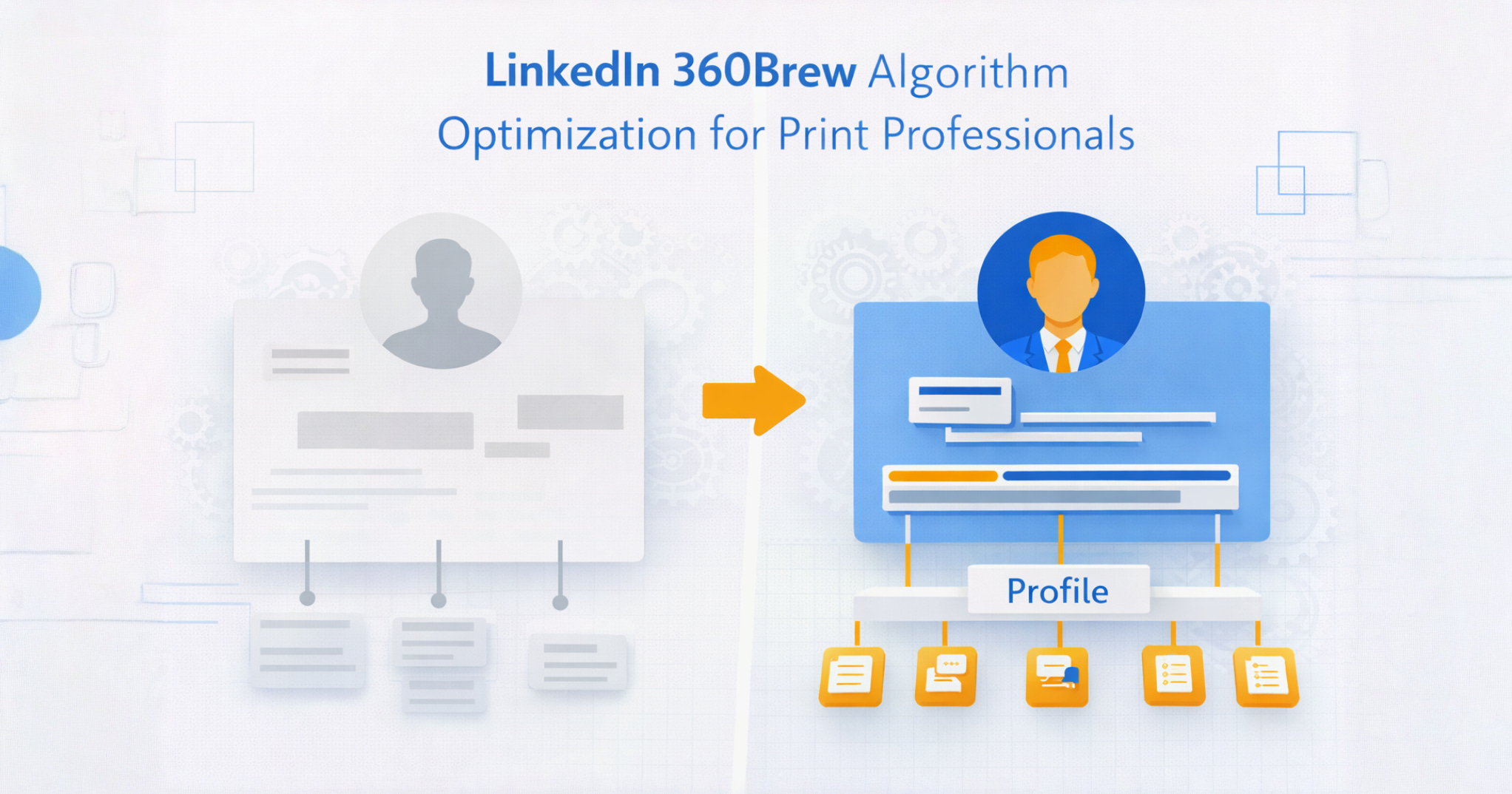
LinkedIn just changed the rules.
The platform’s new AI-driven ranking system—called 360Brew—doesn’t care how often you post or how many likes you get. Instead, it’s reading your entire profile, comparing it to your content, and deciding whether you’re a genuine printing industry expert or just someone throwing content at the wall.
For print shop owners, DTF specialists, equipment suppliers, and industry consultants, this is either your biggest opportunity in years or a silent killer of your visibility.
Here’s everything you need to know, written specifically for the printing industry.
What 360Brew Actually Is (And Why It Matters for Printing Pros)
360Brew is LinkedIn’s AI-powered recommendation engine that treats your profile and posts as a unified signal. Think of it as LinkedIn’s attempt to solve a problem: too many people gaming engagement with generic content while actual experts get buried.
LinkedIn and independent practitioners describe 360Brew as a large AI model that evaluates your profile, content and interactions together, with stronger emphasis on profile completeness, topical consistency and meaningful engagement than the older system.
The algorithm now prioritizes:
Coherence: Does your headline match what you post about?
Expertise: Do your posts demonstrate real knowledge in a specific area?
Relevance: Are the right people (your actual target audience) engaging with your content?
What this means for print professionals:
When you shift from generic business content to focused printing expertise, something predictable happens: total engagement numbers drop, but the quality of conversations increases dramatically. You lose the random scrollers who liked motivational quotes. You gain print shop owners asking specific questions about their operations.
Many practitioners report a similar pattern: fewer total reactions, but more conversations with relevant buyers and decision‑makers. That’s 360Brew working as designed—filtering for relevance over volume.
The Three Rules of 360Brew for Printing Professionals
Rule 1: Profile-Content Alignment Is Everything
Your headline, About section, Experience section, and posts must tell one consistent story.
Unfocused profiles suffer from drift:
Headline claims one expertise
Posts jump between unrelated topics
Algorithm can’t classify you as an expert in anything specific
Your content gets shown to random audiences, not your target buyers
Focused profiles gain traction:
Headline states specific outcome for specific audience
Posts consistently address that same focus area
Algorithm recognizes sustained expertise
Your content reaches shop owners, production managers, buyers actively researching your topic
The difference isn’t writing skill or production value. It’s coherence. Pick your lane, stay in it, and 360Brew amplifies your reach within that specific audience.
Rule 2: Meaningful Engagement Beats Vanity Metrics
360Brew can detect shallow engagement. Twenty “Great post!” comments from random people matter less than three substantive comments from actual print shop owners discussing specific challenges.
For print industry creators, this means:
Stop chasing likes from the general LinkedIn crowd
Start building real conversations with shop owners, suppliers, and operators
Comment thoughtfully on posts from your niche (with specific insights, not generic praise)
Join discussions where actual printing problems are being solved
Rule 3: Your Opening Lines Control Everything
The first 2-3 sentences of every post set the context for both readers and the algorithm.
Weak openers waste the algorithm’s attention: “I’ve been thinking about something important in the DTF industry lately...” tells 360Brew nothing about your expertise or who should see the content.
Strong openers establish immediate context and signal expertise. They state a problem, share an operational observation, or lead with a metric that matters to your target audience.
This isn’t about hooks or engagement bait. It’s about giving the algorithm enough context in the first sentence to classify your content accurately and show it to the right professionals.
Your 6-Step LinkedIn Profile Optimization Blueprint
Step 1: Profile Photo — The Trust Signal You Can’t Skip
360Brew factors profile completeness into visibility. No photo = incomplete profile = lower distribution of your posts.
For print professionals, your photo should signal:
Production floor credibility (not stock corporate headshot)
Approachable expertise (not salesy)
Recent and professional (within 2 years, well-lit, clear)
Quick DIY guide:
Clean background (production area or office)
Natural lighting near window
Camera at eye level
Head/shoulders filling the frame
Slight smile, direct eye contact
Your photo gets you past the first trust filter. Make it count.
Step 2: Define Your Printing Niche and Value Statement
Pick ONE specific area within printing and write a single-sentence positioning statement.
Examples:
“I help small garment shops add DTF services without buying new equipment”
“I solve color consistency problems for wide-format vehicle wrap installers”
“I help DTF operators cut gang sheet waste by 30%+”
“I teach print shops how to automate quote generation and job tracking”
“I help sign shops transition from eco-solvent to latex printing”
Write yours now. Everything else builds from this statement.
Step 3: Rewrite Your Headline for Outcomes
Your headline should follow this formula:
[Who you help] + [Specific outcome] + [Your method/tool]
Print industry examples:
“Helping DTF print shops cut material waste 35% with better gang sheet planning”
“RIP workflow consultant | Reduce color correction time 50% for wide-format shops”
“Pre-press automation for screen printers | Cut file prep time 60%”
“DTF equipment specialist | 200+ shops trained to scale past 500 transfers daily”
Notice: No generic words like “passionate,” “innovative,” or “helping businesses grow.” Only specific outcomes for specific people.
Step 4: Rebuild Your About Section
Write it conversationally, speaking directly to your ideal customer (print shop owner, production manager, etc.).
Structure:
Who you help (one sentence, specific audience)
What problem you solve (concrete pain point they recognize)
How you solve it (your approach/tools/framework)
What outcomes you deliver (measurable results or examples)
Call to action (what they should do next)
Guidelines for your About section:
Address your reader directly (use “you” and “your”)
Lead with the problem they recognize, not your credentials
State your approach in operational terms (what you actually do)
Include concrete outcomes where possible (reduced waste, faster workflows, specific improvements)
End with clear next step (follow, connect, visit website)
Keep it:
Under 300 words
Scannable (short sentences, line breaks)
Results-focused (outcomes, not credentials)
Conversational (write like you’d talk to a shop owner at a trade show)
Your About section isn’t your resume. It’s your answer to “Why should I care?” Write it from the reader’s perspective, not yours.
Step 5: Align Your Experience Section
For each role, highlight outcomes and expertise that map to your content themes.
Transform generic job descriptions into proof of expertise:
Replace activity lists with outcome statements
Quantify improvements where possible (percentages, dollar amounts, time saved)
Use terminology that matches your post topics
Focus on problems solved, not duties performed
Your Experience section should read like evidence of your expertise in your chosen niche. If you post about workflow optimization, your job descriptions should demonstrate workflow optimization results. If you post about cost reduction, show cost reduction outcomes.
The goal isn’t to impress with title or company size. It’s to prove you’ve solved the problems your target audience faces.
Step 6: Build a Focused Content Strategy
Pick 2-3 core topics within your niche and publish ONLY about those.
Example content pillars for DTF specialist:
Gang sheet optimization (layouts, planning, tools)
Cost analysis and pricing (material costs, ROI calculations)
Workflow efficiency (pre-treatment, curing, troubleshooting)
Posting strategy:
2-3x per week (consistency beats frequency)
Every post starts with a strong, specific opener
Comment thoughtfully on 3-5 relevant posts daily
Track which topics generate qualified conversations
90-day test: Pick your topics, commit to 90 days of focused content. If you haven’t seen measurable improvement in qualified reach and conversations, adjust your topics—but not before 90 days.
How to Write Posts That 360Brew Amplifies
The Opening Line Framework
Bad openers:
“I’ve been thinking about...”
“Here’s something important...”
“Hot take:”
Good openers (print industry):
“Banner production rarely lost margin at the printer—it lost it in finishing.”
“DTF white underbase calibration drifts faster than CMYK. Weekly reference jobs catch this before customer complaints do.”
“Three checks before sending DTF jobs to print: white underbase preview, stroke weight (2pt minimum), color count confirmation.”
Formula:
Lead with specific problem, pattern, or metric
Signal expertise in first sentence
Make it scannable (under 140 characters)
Engagement Strategy That Signals Expertise
360Brew rewards meaningful engagement within your niche.
Shallow engagement:
Generic praise (”Great post!”)
Emoji reactions without context
Thanks without substance
Substantive engagement:
Share specific operational experience related to the topic
Ask questions that demonstrate understanding
Offer alternative approaches or complementary methods
Reference actual results from your own operations
The algorithm distinguishes between someone commenting everywhere and someone contributing genuine expertise within a specific niche. One substantive comment from a recognized expert in your field matters more than twenty generic reactions.
Your engagement strategy:
Spend 15 minutes daily commenting on posts from print shop owners, suppliers, and industry peers
Share specific insights, results, or questions (not generic praise)
Build real relationships with 10-15 key people in your niche
This creates a network effect: LinkedIn sees you as embedded in the printing community and amplifies your reach within it
Common Mistakes That Kill Your 360Brew Visibility
Mistake 1: Topic Drift
Posting about DTF printing one week, then AI tools, then general entrepreneurship, then back to printing.
Fix: Pick your 2-3 topics and stick to them for at least 90 days. Narrow focus = broader reach to the right people.
Mistake 2: Profile-Content Mismatch
Profile talks about wide-format printing; posts are about DTF and screen printing.
Fix: Either update your profile to match your content or shift your content to match your profile positioning.
Mistake 3: Weak Opening Lines
Starting posts with vague statements that give the algorithm no context about your content or expertise.
Fix: Open with specific operational observations, concrete problems, or relevant metrics. Give 360Brew enough information in the first sentence to classify your content accurately.
Mistake 4: Chasing Generic Engagement
Focusing on getting likes from random LinkedIn users instead of building conversations with actual print professionals.
Fix: Measure success by qualified conversations and inquiries, not total engagement numbers.
Mistake 5: Posting Frequency Over Quality
Publishing daily with shallow content instead of 2-3x/week with substantive, actionable insights.
Fix: Consistency in topic and quality beats posting frequency.
Your 30-Day 360Brew Optimization Action Plan
Week 1: Profile Foundation
Update profile photo (use DIY guide above)
Write your niche positioning statement
Rewrite your headline using the outcome formula
Rebuild your About section (who you help, problem, approach, outcomes)
Update your Featured section with proof pieces
Week 2: Content Strategy
Define your 2-3 core topics
Create a list of 20 post ideas within those topics
Write 4 posts with strong opening lines (schedule 2/week)
Join 3 LinkedIn groups where your target audience hangs out
Week 3: Engagement & Network
Identify 15 key people in your niche to follow and engage with
Spend 15 min/day leaving substantive comments on their posts
Respond to every comment on your posts with thoughtful replies
Share insights in 2-3 LinkedIn groups
Week 4: Measure & Refine
Review analytics: Which posts reached the most print professionals?
Identify your 2 best-performing topics and double down
Refine your opening line strategy based on what worked
Set up tracking: Posts published, qualified conversations started, inquiries received
Get the Complete 360Brew Optimization System
I’ve compiled everything you need into a comprehensive guide: 6 Prompts to 10x Your LinkedIn Profile — Large Format & DTF Edition
Inside you’ll find:
Prompt 1: Profile Photo Strategy (specific guidance for print professionals)
Prompt 2: Headline Optimization (copy-paste prompt for ChatGPT/Claude)
Prompt 3: About Section Rewrite (conversational, expertise-driven)
Prompt 4: Experience Section Alignment (map job history to content themes)
Prompt 5: Post Opening Lines (generate strong hooks for any topic)
Prompt 6: Content Theme Definition (build 4-week content calendar)
Each prompt is tailored specifically for large format, DTF and wide format print professionals. Copy, paste, fill in your specifics and you get 360Brew‑aligned profile copy you can use immediately.
→ Download the complete guide here
Final Thoughts: This Is Your Moment
LinkedIn’s 360Brew algorithm isn’t a problem—it’s an opportunity.
While most print professionals ignore these changes and wonder why their reach is declining, you can build a highly targeted presence that reaches the exact people you want to connect with: print shop owners researching DTF, production managers solving workflow problems, buyers evaluating equipment.
The formula is simple:
Profile photo (trust signal)
Pick one clear niche
Align every element of your profile to that niche
Post consistently about 2-3 specific topics
Engage meaningfully with your actual target audience
Measure by qualified conversations, not vanity metrics
Start with your profile photo this week. Rewrite your headline next. You’ll see results within 30 days.
What’s your LinkedIn optimization plan?
→ Share this guide with a print pro who needs to fix their LinkedIn presence